
Our Story
From embroidery to embroidered carpets
The Hunza Carpet Innovative Initiative
The vision of Hunza Carpet sparked off in 1995, when the Aga Khan Rural Support Programme generously provided the services of an international specialist on natural dyes. Traditional weaving in Hunza had historically been very basic — limited to a few senior citizens making coarse goat and yak hair rugs. This new initiative transformed the carpet landscape of Hunza by training young people, and giving them the opportunity to share the benefits of cultural tourism.
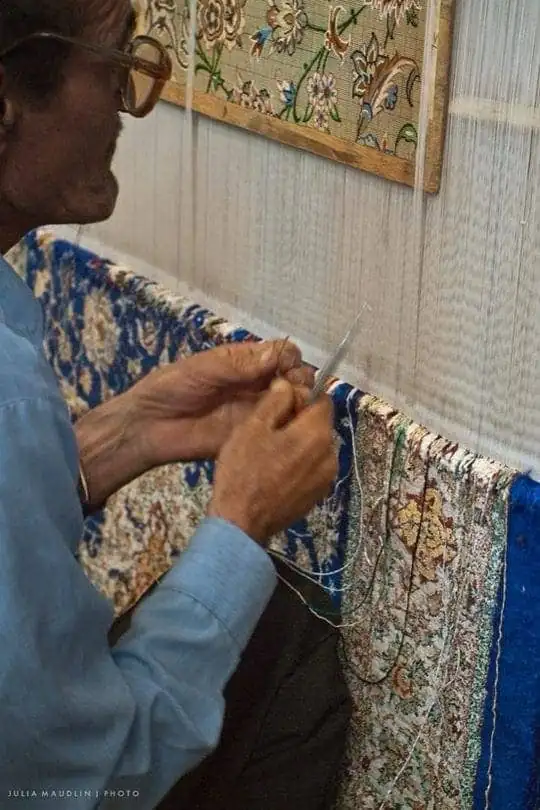
Within a year, a nucleus of 15 young trainees — under the tutelage of Turkmen master weavers — themselves became master trainers. Since 1996, more than 250 women have been trained in carpet and soumak rug weaving. A team of qualified designers and dyers ensures a consistently high product quality. It is a tribute to the dignity of Hunza people that no child labour is used during production, wages remain fair, and the training of weavers continues.
Carpet making in Hunza is powered by a secret weapon — embroidery. Embroidery is an ancient tradition in Hunza, where women originally made pillbox caps for their personal use. These caps were embroidered with Chinese silk brought to Hunza through the Silk Route on caravans, double-hump Bactrian camels, alpine yaks and horses over the Mintaka and Kilik passes from Chinese Turkestan.
Determined to revive the quality of the original workmanship, the Hunza Carpet team set out to re-introduce natural dyes and real silk thread, coupled with authentic and sensitive guidance. This created a friendly, family-type environment and a respectable source of income for women, while giving them the opportunity to express their artistic skills.
Today, educated women artisans are trained to embroider and weave with new perspectives — from artistic Islamic and Anatolian kilim designs to completely avant-garde works of modern artists — while continuing to recreate old and previously forgotten local designs found on women's caps, wedding veils and decorative embroideries.
With each object you buy, you take a piece of Hunza with you — secure in the knowledge that you have helped bring prosperity to the women of Hunza, while encouraging their creativity, skill and work.
The craft
Embroidery & its motifs
Carpet making in Hunza is powered by a secret weapon — embroidery. These are the stitches and motifs that have travelled the Silk Route and now find new life in Hunza Carpet's work.
Stitches
Erāghi
Fine silk-thread embroidery of cross and roll stitches, or a combination of the two.
Charsuta chuk
A more rustic form worked in thicker woolen thread with similar stitching.
Qalmi
Silk-thread embroidery using long and short stitches to create floral designs.
Zardōzi
Metal-thread embroidery worked in silver or golden threads, collectively called qalābātu.
Traditional motifs
- TurangkishIbex horns
- TamutsSnow leopard
- Urki itsuWolf's foot
- KishtimutsBoat
- Herimani chukMillipede