
Anatolia, Turkey
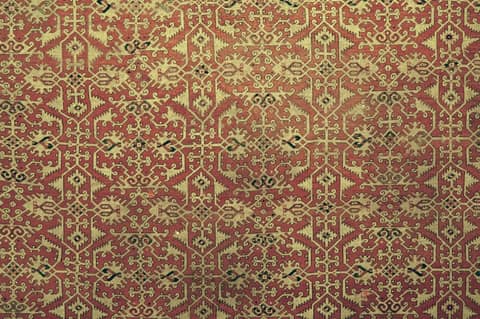
Ottoman Lattice of Stars in Red and Gold
Turkish & Anatolian · Representative imagery
This fragment-style detail shows a dense Ottoman-inflected lattice in which crimson and gold interlock around eight-pointed stars and stepped cruciform medallions. The continuous diamond grid expresses the endless-garden ideal favored in Anatolian and court weaving, with dark indigo flecks adding depth and rhythm. Hand-knotted in wool, the warm, sun-faded coloring is signature to the tradition. Shown as a representative example of the design family, not a specific provenance.
The tradition
Anatolia, Turkey
Anatolian weaving is the great geometric counterpart to Persia's curving florals. Across Turkey, village and town weavers — Oushak, Bergama, Konya and others — have for centuries built designs from bold, angular forms and a warm, often softer palette, including the celebrated prayer rugs with their directional niche.
Where Persian city rugs aim for painterly detail, Anatolian rugs prize clarity and rhythm: large abstracted medallions, stepped borders and motifs whose meaning the weaver knew by heart.
Motifs & meaning
Reading the design
Anatolian motifs are emblematic and protective, many tied to the lives of the women who wove them.
Elibelinde
A stylised woman with hands on hips — motherhood and fertility.
Mihrab (prayer niche)
The arch orienting a prayer rug toward Mecca.
Star / Solomon's seal
Protection and the warding of evil.
Ram's horn (koçboynuzu)
Power, heroism and fertility.
Materials & technique
How it is made
Hand-knotted with the symmetric (Turkish, or Ghiordes) knot in wool on a wool foundation, giving the sturdy, bold-patterned surface typical of Anatolian rugs.
Interested in ottoman lattice of stars in red and gold?
Leave your email or WhatsApp and we'll share current availability, pricing and condition.