
Anatolia, Turkey
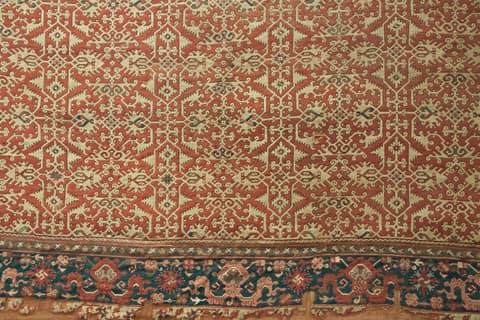
Ushak-Style Lattice Field with Indigo Border
Turkish & Anatolian · Representative imagery
This detail illustrates the classic west-Anatolian Ushak manner, where a brick-red ground is covered by an all-over lattice of small star and rosette forms outlined in soft ivory and gold. The endless repeat suggests abundance and continuity, while the indigo border with palmette-and-vine motifs frames the field in the courtly Ottoman taste. Knotted in wool on wool with the symmetric Turkish knot, the muted, warm tonality is characteristic of the regional palette. Presented as representative imagery of the tradition.
The tradition
Anatolia, Turkey
Anatolian weaving is the great geometric counterpart to Persia's curving florals. Across Turkey, village and town weavers — Oushak, Bergama, Konya and others — have for centuries built designs from bold, angular forms and a warm, often softer palette, including the celebrated prayer rugs with their directional niche.
Where Persian city rugs aim for painterly detail, Anatolian rugs prize clarity and rhythm: large abstracted medallions, stepped borders and motifs whose meaning the weaver knew by heart.
Motifs & meaning
Reading the design
Anatolian motifs are emblematic and protective, many tied to the lives of the women who wove them.
Elibelinde
A stylised woman with hands on hips — motherhood and fertility.
Mihrab (prayer niche)
The arch orienting a prayer rug toward Mecca.
Star / Solomon's seal
Protection and the warding of evil.
Ram's horn (koçboynuzu)
Power, heroism and fertility.
Materials & technique
How it is made
Hand-knotted with the symmetric (Turkish, or Ghiordes) knot in wool on a wool foundation, giving the sturdy, bold-patterned surface typical of Anatolian rugs.
Interested in ushak-style lattice field with indigo border?
Leave your email or WhatsApp and we'll share current availability, pricing and condition.