
Caucasus, Azerbaijan & Anatolia
Pictorial Tree Of Life By Norita San
Soumak Rugs
1.43 m × 1.57 m
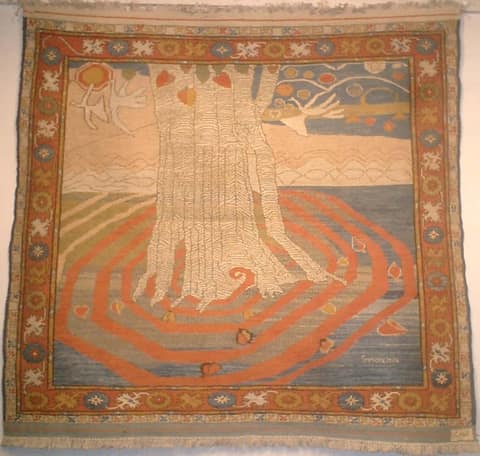
An original pictorial soumak designed by Norita San, depicting a great pale tree whose roots dissolve into concentric ripples of water beneath a wide sky with birds and a low sun. Scattered fallen leaves and a softly drawn landscape give the panel a poetic, painterly quality unusual in flat-weave. Worked in naturally dyed handspun wool with the weft-wrapping soumak technique and a floral palmette border, it reads as a contemplative, artist-signed tree-of-life composition. Approximately 1.43 m by 1.57 m.
The tradition
Caucasus, Azerbaijan & Anatolia
Soumak is one of the oldest flat-weaving techniques of the Caucasus and Central Asia, its name often linked to the town of Shamakhi in Azerbaijan. Unlike a knotted pile carpet, a soumak is built by wrapping the coloured weft yarns over and around the warp threads, producing a flat, hard-wearing surface with a distinctive herringbone-like texture on the front and loose floating threads on the back.
At Hunza Carpet the soumak loom carries both the classic vocabulary of the Caucasus — Shahsavan, Verneh and Shirvan designs — and original Hunza compositions drawn from the valley's own embroidery, so a single shelf can hold an Azerbaijani medallion piece beside an ibex design that belongs only to the Karakoram.
Motifs & meaning
Reading the design
Soumak designs are emblematic rather than pictorial: bold medallions, hooked diamonds and rows of stylised creatures, each carrying meaning passed down through generations of weavers.
Stepped medallion
Central authority and protection of the home.
Hooked diamond (latch-hook)
Warding off the evil eye and misfortune.
S-form / dragon
An ancient Caucasian guardian motif tied to water and fertility.
Running-dog border
Continuity and a protective boundary around the field.
Ibex (Hunza design)
The wild mountain goat of the Karakoram — strength and surefootedness.
Materials & technique
How it is made
Worked in naturally dyed, handspun wool on a wool foundation. The weft-wrapping technique gives a flat, reversible-feeling face that is dense and durable, prized for floors and equally at home on a wall.
Interested in pictorial tree of life by norita san?
Leave your email or WhatsApp and we'll share current availability, pricing and condition.