
Qum, Hereke & Isfahan
Silk Repeating Gul Field in the Turkmen Manner
Silk Rugs · Representative imagery
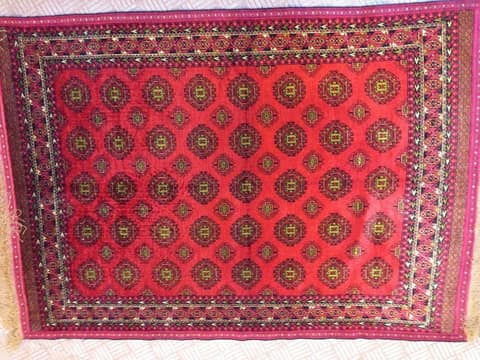
A representative silk carpet laid out with an all-over lattice of repeating gul medallions in gold and dark tones glowing against a deep madder-red field, framed by many narrow guard borders. The disciplined repeat of the tribal gul, an ancestral emblem of the Turkmen weaving tradition, gives the piece its rhythmic, jewel-like surface. Knotted in fine silk, the sheen lends the classic red-ground Bukhara design an unusual luminosity and depth.
The tradition
Qum, Hereke & Isfahan
Silk rugs represent the finest end of the knotted tradition. Woven in centres such as Qum and Isfahan in Iran and Hereke in Turkey, they use silk for both the foundation and the pile, allowing extraordinarily high knot counts and a level of detail impossible in wool.
Silk's natural sheen makes these rugs shift in colour as you move around them, so a silk carpet reads almost like a changing painting — often hung or used as a showpiece rather than walked on.
Motifs & meaning
Reading the design
Silk rugs carry the classical court repertoire, rendered in the finest possible detail.
Central medallion
The garden pool or dome at the heart of the design.
Fine floral vinework
Scrolling arabesques of the Persian garden.
Hunting & garden scenes
Paradise imagery from the court tradition.
Prayer niche (Hereke)
The directional arch of the finest Turkish silks.
Materials & technique
How it is made
Hand-knotted entirely in silk at very high knot counts, giving the luminous sheen, fine detail and jewel-like colour that define the finest rugs.
Interested in silk repeating gul field in the turkmen manner?
Leave your email or WhatsApp and we'll share current availability, pricing and condition.