
Iran — Tabriz, Kashan & Isfahan
Persian Indigo-Field Boteh and Star Medallion Rug
Persian Carpets · Representative imagery
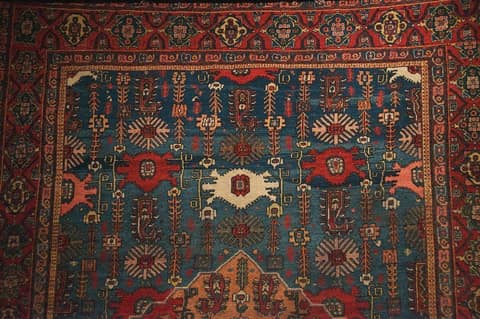
A representative Persian village rug set on a rich indigo field strewn with boteh, star-rosette medallions and stylised flowering plants in brick red, ivory and gold. The semi-geometric drawing, with its turtle-pattern main border and barber-pole guards, reflects the tribal and village tradition of weaving centres across the Persian plateau. Knotted in hand-spun wool, the boteh (the seed or paisley motif) carries old associations of fertility and life.
The tradition
Iran — Tabriz, Kashan & Isfahan
Persian carpets are the benchmark of the knotted-pile tradition, refined over centuries in the great workshop cities of Iran. City rugs from Tabriz, Kashan and Isfahan are known for curvilinear floral designs — a central medallion floating on a field of scrolling vines — drawn first on a cartoon and then knotted with great precision.
Alongside the formal city style runs a tribal and village tradition with bolder, more geometric versions of the same garden imagery. Both share the Persian idea of the carpet as an eternal garden in bloom.
Motifs & meaning
Reading the design
Persian design is a language of the garden and of paradise, rendered in flowing curvilinear forms.
Central medallion (toranj)
The sun, a pool, or the dome of a garden pavilion.
Boteh
The seed-and-flame paisley, a symbol of life and fertility.
Shah Abbasi palmette
The grand court flower of the Safavid era.
Tree of life
Paradise and the connection of earth to heaven.
Materials & technique
How it is made
Hand-knotted, traditionally with the asymmetric (Persian) knot, in fine wool and silk on a cotton or silk foundation — high knot counts allow the curving floral detail Persian rugs are famous for.
Interested in persian indigo-field boteh and star medallion rug?
Leave your email or WhatsApp and we'll share current availability, pricing and condition.