
Iran — Tabriz, Kashan & Isfahan
Persian Crimson-Field Floral Corner with Vine Border
Persian Carpets · Representative imagery
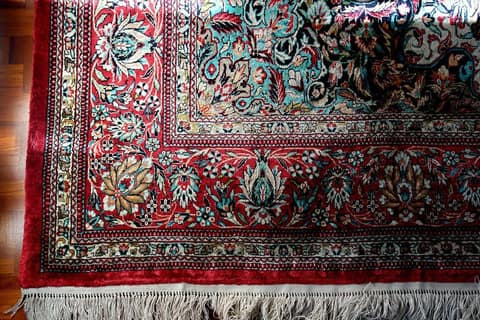
A representative Persian city carpet shown at the corner, where a deep crimson field meets a multi-band border of ivory and teal palmettes, serrated acanthus leaves and scrolling vine. The curvilinear floral drawing, with its lustrous pile and fine secondary guard stripes, follows the refined urban tradition of centres such as Kashan and Qum. Such pieces are hand-knotted in fine wool or silk on a cotton foundation, the dense knotting allowing the flowing rosette-and-leaf design typical of classical Persian workshops.
The tradition
Iran — Tabriz, Kashan & Isfahan
Persian carpets are the benchmark of the knotted-pile tradition, refined over centuries in the great workshop cities of Iran. City rugs from Tabriz, Kashan and Isfahan are known for curvilinear floral designs — a central medallion floating on a field of scrolling vines — drawn first on a cartoon and then knotted with great precision.
Alongside the formal city style runs a tribal and village tradition with bolder, more geometric versions of the same garden imagery. Both share the Persian idea of the carpet as an eternal garden in bloom.
Motifs & meaning
Reading the design
Persian design is a language of the garden and of paradise, rendered in flowing curvilinear forms.
Central medallion (toranj)
The sun, a pool, or the dome of a garden pavilion.
Boteh
The seed-and-flame paisley, a symbol of life and fertility.
Shah Abbasi palmette
The grand court flower of the Safavid era.
Tree of life
Paradise and the connection of earth to heaven.
Materials & technique
How it is made
Hand-knotted, traditionally with the asymmetric (Persian) knot, in fine wool and silk on a cotton or silk foundation — high knot counts allow the curving floral detail Persian rugs are famous for.
Interested in persian crimson-field floral corner with vine border?
Leave your email or WhatsApp and we'll share current availability, pricing and condition.