
Anatolia, Persia & the Caucasus
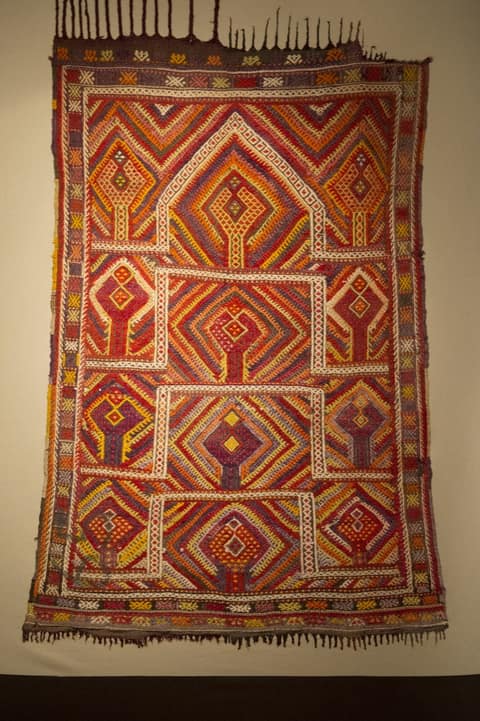
Embroidered Cicim Kilim with Concentric Diamonds
Kilims · Representative imagery
This flat-woven cicim-style kilim layers brocaded diamonds and stepped, candelabra-like forms in warm reds, oranges and violets across a finely banded field. The interlocking diamonds and hooked terminals are age-old fertility and protection motifs of the nomadic weaving tradition. The reversible weft-faced surface with raised embroidered detailing gives the dense, jewel-toned texture typical of the family. Offered as representative imagery rather than a specific piece.
The tradition
Anatolia, Persia & the Caucasus
A kilim is a flat-woven, pile-less rug made by interlacing coloured weft threads through the warp — the same family of technique used across Anatolia, Persia and the Caucasus. Because the design is the structure, kilims are light, reversible and crisp, with motifs built from interlocking diamonds and triangles.
The characteristic small gaps where two colours meet — the slit-weave 'slits' — give kilims their precise, slightly stepped geometry and have become part of their visual signature.
Motifs & meaning
Reading the design
Kilim motifs are among the oldest in weaving, shared across many cultures.
Elibelinde
Hands-on-hips woman — fertility and motherhood.
Diamond field
Repeating lozenges symbolising protection and abundance.
Hook / horn
Ram's horns standing for strength and fertility.
Comb (tarak)
A motif guarding birth and warding the evil eye.
Materials & technique
How it is made
Flat-woven in slit-weave tapestry technique with naturally dyed wool — no pile, so the same crisp pattern reads on both faces.
Interested in embroidered cicim kilim with concentric diamonds?
Leave your email or WhatsApp and we'll share current availability, pricing and condition.