
Afghanistan & the Turkmen steppe
Crimson Tekke Rug In Raking Light
Afghan & Turkmen · Representative imagery
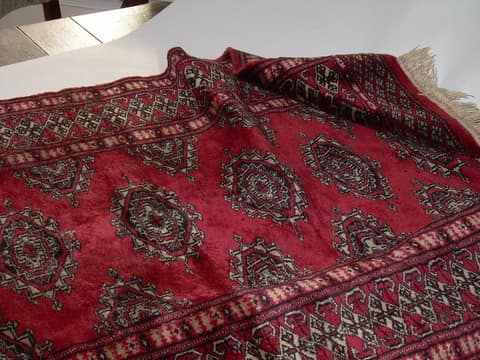
Photographed at an angle to catch its plush nap, this deep crimson Turkmen-family rug shows rows of stepped octagonal güls outlined in black and ivory across a saturated madder ground. The repeating tribal medallions and latch-hook borders are hallmarks of the steppe weaving tradition, where the gül functions as both ornament and identity. Lustrous, densely knotted wool and a soft ivory fringe complete the classic look.
The tradition
Afghanistan & the Turkmen steppe
The Turkmen tribes of Central Asia and northern Afghanistan wove some of the most disciplined carpets ever made: deep madder-red fields filled with rows of repeating güls. Each major tribe — Tekke, Salor, Ersari, Yomut — carried its own gül, so the medallion functioned almost as heraldry, identifying who had made the piece.
Afghan war and trade carried these designs westward, and the 'Afghan' carpet of the bazaar — rich red with bold elephant-foot güls — remains one of the most recognisable tribal styles in the world.
Motifs & meaning
Reading the design
Turkmen design is built almost entirely from the repeating gül and its companions.
Gül
The tribe's heraldic medallion, repeated as a badge of identity.
Elephant-foot (Filpa)
The large octagonal gül of Afghan weaving.
Kepse / Dyrnak gül
Tribe-specific medallion variants of the Yomut and others.
Kufic border
An angular guard band derived from early script.
Materials & technique
How it is made
Hand-knotted in lustrous wool on a wool foundation, with the dense, even pile and predominant madder red that define Turkmen and Afghan weaving.
Interested in crimson tekke rug in raking light?
Leave your email or WhatsApp and we'll share current availability, pricing and condition.